
Home/Free tools/Dimensional weight calculator
Free DIM weight calculator

Stop paying to ship air

Enter the box size and weight to see its dimensional weight and the weight a carrier bills. The calculator shows which side to shrink so the box bills on what it actually weighs.
Free, no sign-upRuns in your browserYour numbers never leave your device
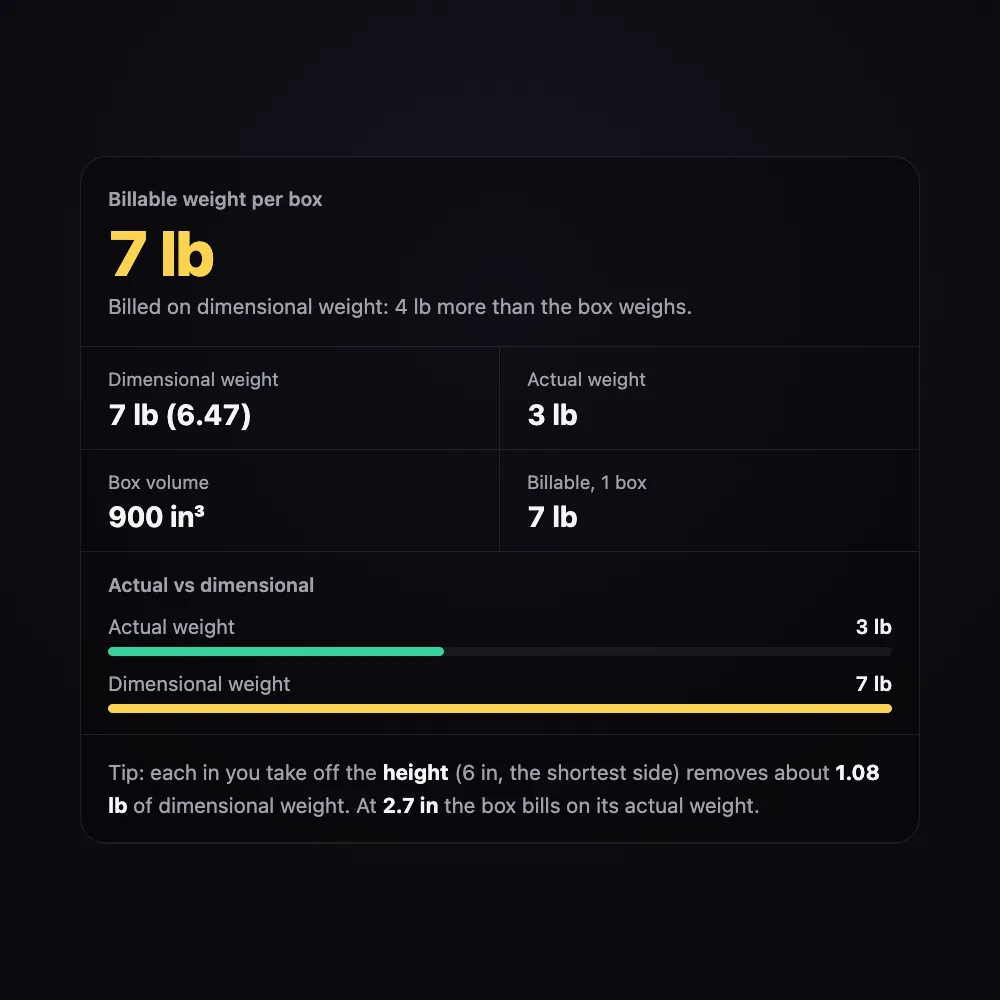
A 15 × 10 × 6 inch box weighing 3 lb with a 139 divisor: it bills as 7 lb
Free · runs in your browser

Dimensional Weight Calculator

No sign-up. What you type never leaves your device.

Units
Box size
in
in
in
lb
Divisor

Carriers change divisors, rounding rules and size thresholds, and contract rates can use different numbers. Check your carrier’s current rates or your account’s rate sheet before you rely on a result.

Billable weight per box
–
Dimensional weight–
Actual weight–
Box volume–
Billable, all boxes–

How it’s calculated
  • Dimensional weight = length × width × height ÷ divisor
  • Billable weight = the greater of actual weight and dimensional weight
  • With rounding on, a fraction goes up to the next whole pound or kilogram, so 6.47 lb becomes 7 lb.
  • The divisor is the volume a carrier counts as one pound or kilogram. A smaller divisor means a higher dimensional weight.
Features

Everything you need, nothing you don't

Dimensional weight

Length × width × height ÷ divisor, in inches and pounds or centimeters and kilograms.

Billable weight

The greater of actual and dimensional weight, per box and for the whole shipment.

Carrier presets

UPS, FedEx and USPS divisors, each with where it was published. Or type your own.

Carrier rounding

Round each side up to a whole inch or centimeter, and the weight up to a whole pound or kilogram.

Shrink tip

Shows which side to cut and how short it needs to be to bill on actual weight.

Private

The math runs in your browser. Nothing is saved or sent.

How it works

Done in 3 steps

01

Enter the box

Length, width, height, actual weight and the number of boxes.

02

Pick a divisor

Choose a carrier preset or type the divisor from your rate sheet.

03

Read the result

Dimensional weight, billable weight and a tip on which side to shrink.

FAQ

Questions about dimensional weight calculator

Is the dimensional weight calculator free?
Yes. It's free with no sign-up.
Are my numbers saved or sent anywhere?
No. The calculator runs in your browser. Your numbers never leave your device.
What is dimensional weight?
It's a weight carriers work out from a box's size: length × width × height divided by a number called the divisor. If it's higher than what the box actually weighs, you pay for the higher number. A large, light box can cost as much to ship as a small, heavy one.
Where do the divisors come from?
Each preset names its source, checked October 2026. UPS lists 139 for Daily Rates and 166 for Retail Rates in inches and pounds, and 5,000 for centimeters and kilograms, on its Shipping Dimensions and Weight page. FedEx uses 139 for inches and pounds and 5,000 for centimeters and kilograms in its dimensional weight FAQ. USPS Postal Bulletin 22705 sets 139 for Priority Mail Express, Priority Mail, USPS Ground Advantage and Parcel Select from July 12, 2026, for boxes over 1 cubic foot, with each side rounded up to the next whole inch. Carriers change these, so check your carrier's current rates.
My carrier uses a different divisor. Can I still use this?
Yes. Pick Custom and type the divisor from your rate guide or account rate sheet. Contract rates sometimes use a higher divisor than published retail rates.
How do I lower my dimensional weight?
Use the smallest box that protects the product. Cutting the shortest side removes the most volume per inch, and the tip in the calculator shows how far it needs to go. Soft goods often ship cheaper in a padded mailer.

Calculate DIM weight today

14 days free, 200 credits, no card.

Start free trial
✖